
From Pymble to the Pit: How Isla Turned Silence Into Sound
- Eli Ward

- Dec 1, 2023
- 4 min read
Updated: Nov 11, 2025
December 1, 2023
There’s a point in every Isla song where you can feel her stop holding back. It’s not a scream, not exactly, but something older, more primal. There long before we had the words for it.

Raised in Pymble on Sydney’s north shore, Isla was the daughter of a High Court judge she only references in song. “Too much there,” she says when asked. “So don’t.” Isla carried the kind of contradiction polite suburbs notice but don’t understand. She could be brilliant and impossibly magnetic, the kid who turned every quiet room volatile. No one knew what sat beneath it, only that her noise had weight.
By fifteen she was playing youth centers, shaking walls not built for that kind of sound. Isla never built her art around escape. She built it around confrontation. Her early shows blurred the line between breakdown and sermon, whispered confessions erupting into waves of distortion, lyrics written like autopsies of moments too personal to name, yet delivered with unnerving control. “It captured me in survival mode,” she says. “It wasn’t pretty, but it suited the punk energy I had to live in.”

Years later Her first EP, Experiments in Crazy Noise, sounded unhinged because it was. Recorded in the aftermath of the Dominic Ryker trial and her mother’s death, it’s a document of someone refusing to be quiet by screaming.
Polished Vomit: It began with a thought Isla couldn’t shake: “My mother was polished vomit, and I was the reverse.” Her mother looked perfect but was broken beneath the gloss. Isla felt raw, impossible to present neatly, yet knew there was worth under the mess. Polished Vomit is that collision. Beauty turned inside out.
Burning Dominic’s Bridge: Written in the aftermath of the Ryker trial, it marks the night Isla burned Dominc's bridge to freedom. The song is part revenge, part release — a purge of control, money, and manipulation.
PeekABoo: This is Isla describing the moment she met Ethel Ryker — yes, that Ryker, whose family name still carries the echo of the trial that once dominated Sydney headlines. They meet in what Isla calls “the crazy house,” two opposites circling the same insane world of Dominic Ryker (Ethels Father). It starts like a taunt and ends like a mirror: one reads as chaos, the other as control, neither certain which role belongs to whom. PeekaBoo catches that first spark between them, rivalry, recognition, and a charge that would shadow them both.
These songs blur confession and confrontation. Critics called it unstable; fans called it possession. Isla called it “functioning through damage.”
Then came The Stanmore Years— the uneasy calm that followed. Having just been expelled from the Sydney Conservatorium for “undisclosed behaviour,” Isla found herself in an inner-west flat she never quite wanted but learned to use as a kind of laboratory. “It was a strange in-between,” she’s said. “Between trauma and a level of success I didn’t yet know yet understand.”

She’s openly self-critical of that record. “It’s mostly derivative,” she laughs. “But two of those songs saved me.”
Those were "The Porcelain Lie"and Raise the Fourth (A Drop from the Fourth) flashes of the voice she was becoming, where chaos turned deliberate and the noise started to mean something.
That clarity pushed her beyond Sydney. A renowned metal act with Australian roots, a band as heavy in their world as Pantera in the ’90s, had lost its singer to suicide. After seeing Isla’s live videos, they sent someone to check her out. The encounter didn’t go as planned, but Isla moved anyway. She booked her own ticket, found their rehearsal space in Los Angeles, and walked in unannounced. “I just turned up,” she said later. “What’s the worst they could do. Say no?” By nightfall, she’d sung, screamed, and silenced every doubt in the room. By the end of the week, she was their new front-woman.
Raise the Fourth (A Drop from the Fourth) re-recorded.
The band soon re-formed under one name: ISLA

I Know What This Was Always For: fused her voice to machinery. Isla's voice soaring above Meshuggah level heaviness while "A Memory Under Water" is elegy for her mother,
The album showed that fury and grace could share the same breath.The first record proved
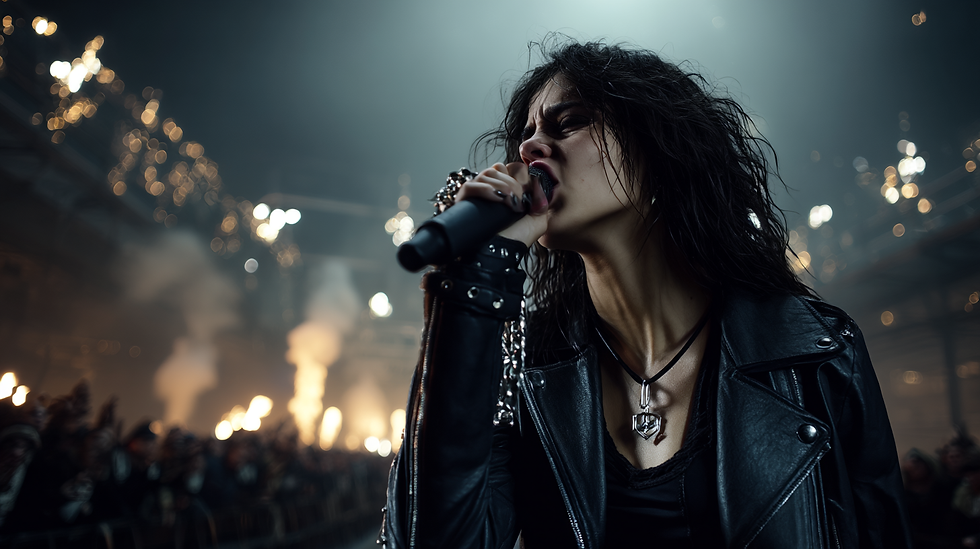
What You Don’t See: became a favorite for its heat felt expression of early trama which many of Isla's fans can unfortunately relate to. This is the key to why people respond to her music in the way they do. Its a shared lived experience on a very human level. Not just the kind of experience Isla had but the pain we all experience at some point and Isla makes it ok to yell it out - at least with headphones. She demands that release in people through her music.

Give It Back: Is a double edged song, half plea, half threat. She demands what was taken from her: her youth, her innocence, her quiet. But it's also warning that she’ll return every scar in full view, onstage, louder than anyone can look away from. Give It Back is both confession and revenge.
Don’t Wake Him Yet: is a slow, devastating account of the boyfriend she lost to overdose, sung like a lullaby you wish you could un-hear.
By the time she performed What You Don’t See live with a full orchestra, Isla had turned noise into architecture. The distortion became orchestration; the rage, arrangement. Onstage at the Grand Concert Hall, alone at a piano.
Offstage, she says little. Online, almost nothing. But you don't need to know the words of one of her songs to feel what she saying.
She isn’t chasing stardom; she’s constructing an emotional system, one listeners can inhabit, even when it hurts.
As one critic wrote, “If catharsis had an operating manual, Isla would’ve written it in blood, metal, and reverb.”
Ethel & Isla are characters from PixelStortion's fictional crime drama series. Their world is adjacent to ours. Dates are accurate.


Comments