
Isla's Emotional Return to the Stage
- Eliza Trenholm

- Oct 21, 2025
- 5 min read
Updated: Nov 11, 2025
October 21, 2025
I didn't intend to write this.
I went to the Turntable Theatre out of curiosity, or maybe cynicism. Isla’s name had been floating around again, with headlines about her “return to form,” the sold-out orchestral shows, and the usual industry mythology about redemption and reinvention.
I’ve never been one for mythology. But what happened that night felt like a rare moment of reality that I can't quite explain yet.

The Setting
Turntable Theatre isn’t built for grandeur. It’s a converted locomotive shed on the old rail line near Redfern, all rusted steel beams and concrete that hums when the wind hits right. The crowd that filled it wasn’t her usual chaos; fewer piercings, more wool coats. Yet, everyone had that same wary anticipation you feel before a storm that may or may not break.
When Isla walked out, black jacket, hair soaked dark under the lights, she looked less like a rock star and more like someone showing up for a reckoning. No greeting, no preamble. Just the piano and a breath.
The first sound wasn’t even a note, just air moving through the mic, then silence, and then a familiar melody made of discordant keys:
“I used to count the cracks my mind painted from above.”
Song: What You Don’t See
The song that broke her, or maybe made her, began with nothing but a gentle melody and Isla’s voice, the piano tuned just slightly off. Then the orchestra crept in, a soft breath of sound. On the line “The other wore perfume like armour,” her drummer joined, never overpowering, just grounding her.
The line “They said I was lucky” gave me, and I think everyone else in the room, goosebumps.
People always talk about that song in whispers because of what it implies. It’s Isla finding a way to speak the unspeakable, to circle around what can’t be said directly. Hearing it live, stripped bare like this, I finally understood why.
It ended abruptly after “The girl I would have been,” followed by a few discordant notes that hung like breath. She didn’t look up, just pressed her palm flat against the grand piano and sat there for a moment. The silence that followed was louder than any applause.
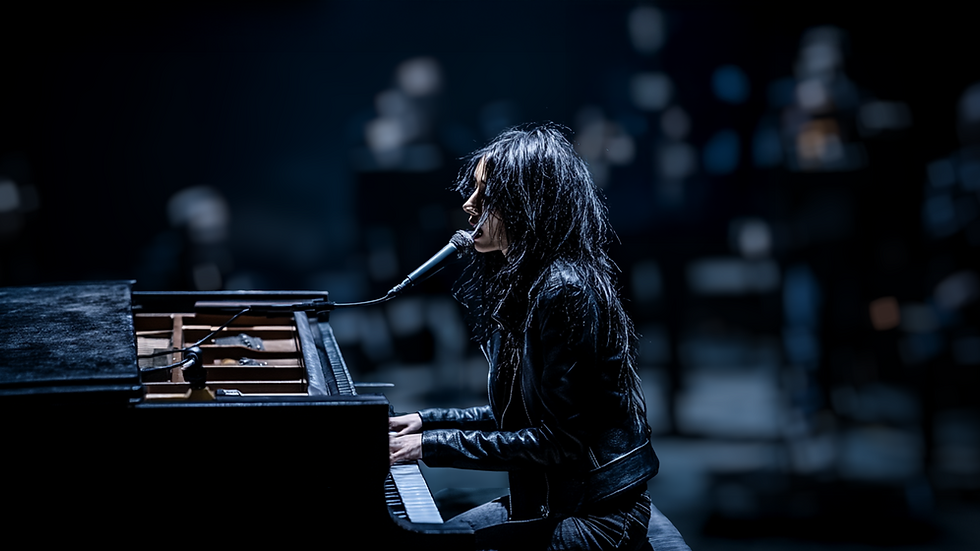
Song: Raise the Fourth (A Drop from the Fourth)
She began this one with a low hum and a few discordant keys, appropriately. The kind of notes that make you hold your breath before you realize you have. Her voice was sweet at first, deceptively calm. The strings crept in behind her, tracing her melody like ghosts that knew where she was going before she did.
Then, on the line “I say ‘open,’ bite the O in half and drop,” a single deep drum hit landed like a body hitting the floor.
Suddenly, the meaning sharpened. You could feel the audience collectively understand what the song was actually about. Not metaphor, not clever wordplay, but the quiet arithmetic of despair.
Her band joined partway through, the familiar faces, older now, each knowing exactly when to appear. Nothing metal. Nothing that interfered with her voice. Nothing that got in the way.
At first, it sounded harmless, almost sweet. Then Isla leaned into the line that confirmed what it was about:
“The crosswalk clicks like it knows what I’ll do.”
A minute later, near the end:
“Pigeons walk like priests as the crowd leans in.”
And then you realize she wasn't writing about a metaphor. She was describing a suicide that didn’t happen, sung in past tense like it did. A kind of emotional sleight of hand that’s less about performance and more about survival.
When she reached the end, “a drop from the fourth,” the orchestra fell into a single, long drone, and Isla just sat there, back arched, eyes closed, holding that space between despair and release.

It didn’t feel like spectacle. It felt like witness.
Somewhere near the end of the night, after a tense pause, she muttered, venomous, clear:
“They know who they are.”
Song: Memory Under Water
Later in the set, Isla introduced the song "A Memory Under Water" with a quiet, almost embarrassed half smile:
“This one’s for my mother.”
It began in near silence: a cello line, barely more than a breath, followed by the slow, resonant pluck of an upright orchestral bass. Together, they moved like currents beneath her voice, the orchestra flowing behind her, eerie, fluid, unsettling, rippling like a memory you’re not sure you’re ready to remember.
Then came her voice, near spoken. Disassociation made audible:
“Feels like a memory surfacing underwater.”
That’s exactly what it felt like, something surfacing that shouldn’t, heavy and half seen.
As the verses unfolded, you could feel the audience piecing it together, the way her mother’s world had narrowed behind doors that looked beautiful from the outside. Isla sang of marble air, of rooms that tilted, of a woman who “dressed her tremor like a grace.” The imagery was delicate, but the meaning wasn’t.
By the second verse, it was clear this wasn’t an elegy. It was an autopsy of silence, of the kind of social composure that buries people long before they die. She never said the word suicide, not once. But when she sang,
“No speeches then. Just noon and stone,”
what she was describing was her mother’s final walk, quiet, deliberate, unseen.
What struck me most wasn’t grief. It was understanding. Isla wasn’t asking for sympathy; she was confronting the inheritance of performance, the mask her mother taught her to wear “like skin.”
The chorus rose like something unwilling to stay buried:
“Logged, like letters never sent, or names in tempered glass that bent.”
By the bridge, her voice thinned to air:
“I keep her absence folded small, a handkerchief behind a wall.”
What I Didn’t Expect
I came in thinking I’d be writing about contrast—punk meets symphony, rage meets refinement. But that’s not what this was. There was no polish. No neat story arc.
It was a woman at the height of her career, unafraid to walk the same corridors that almost killed her, and to make the audience walk them too.
Isla's a real diamond in the rough. She didn’t soften for the orchestra; she made them learn her language.
And maybe that’s what I took away most: she’s not trying to transcend her past. She’s building on it, plank by plank, until the wreckage becomes architecture.
After
When it was over, Isla didn’t bow. She just stepped away from the piano, no grand finale, no swelling strings. Just the quiet tick of equipment cooling down. Then something unexpected happened.
A red-haired woman, mid-twenties, striking, not from the industry, walked onto the stage and hugged Isla, full force. Not staged, not choreographed, something genuine.
At first, I thought it was a fan who’d slipped security. But no one moved to stop it. I learned what I’d seen later.
Song: Ethel's Story
Years ago, when the trial of Dominic Ryker dominated headlines, Isla had been a key witness. Her mother had been Ryker’s partner, possibly wife, though the records blur that line. Isla’s testimony helped put him away. Briefly. He escaped less than a year later and, as of tonight, remains at large.
And the red-haired woman? That was Dominic Ryker’s daughter. You could feel the entire room understand what that hug meant without needing the details. Not forgiveness. Something braver. Recognition.
Isla doesn’t sing for catharsis, she sings through it. She’s proof that some artists don’t survive to tell the story, they tell the story to survive.

Ethel & Isla are characters from PixelStortion's fictional crime drama series. Their world is adjacent to ours. Dates are accurate.


Comments